Labor Cost Calculator UK: Complete Guide to Construction Labor Cost Estimation & Cost Per Hire Formulas
Free comprehensive labor cost calculator for UK construction companies. Calculate cost per hire, labor burden rates, construction labor costs, recruitment expenses, staffing costs, and labor productivity using professional formulas and real-world examples.
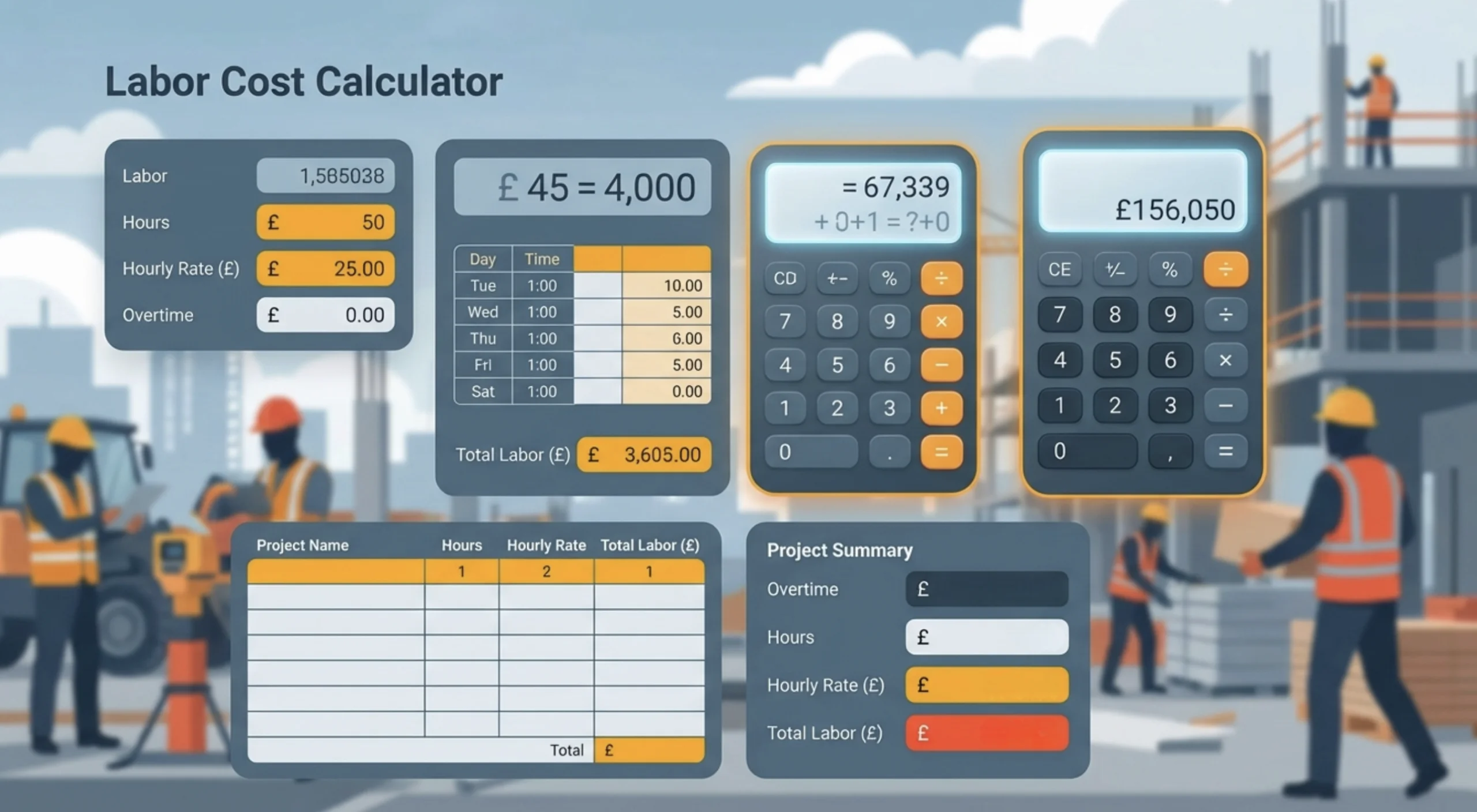
About This Labor Cost Calculator Guide
Accurate labor cost calculation is fundamental for construction project profitability, competitive bidding, and effective workforce management. This comprehensive guide provides UK construction companies with professional labor cost calculator tools, proven formulas for calculating labor costs, detailed cost per hire calculations, labour supply cost analysis , and recruitment cost calculator methodologies. Whether you're calculating construction labor costs, determining cost to hire construction workers, analyzing labor burden rates, or estimating total staffing costs for projects across London , Manchester , Birmingham , and UK-wide, this resource delivers practical calculation tools, real-world examples, and expert guidance from Labourer.Agency's construction staffing specialists.
True Cost Calculator
📋 Agency Scenario
✅ Direct Hire Scenario
*Includes standard ~43% load for NI, Pension, Holiday Pay.
Understanding Labor Costs: Complete UK Construction Guide
What is Labor Cost?
Labor cost represents the total expense of employing workers including direct wages, employer taxes, insurance, benefits, overhead, and recruitment expenses. For UK construction workers , calculating labor costs accurately is essential for project profitability, competitive bidding, workforce planning, and financial management. Understanding the complete cost of labor enables better decision-making around direct hiring versus staffing agency solutions , temporary versus permanent employment, and overall workforce optimization strategies.
Components of Total Labor Cost
💷 Direct Labor Cost
- Hourly wages or salary
- Overtime payments
- Shift premiums
- Performance bonuses
📊 Labor Burden
- Employer's NI (13.8%)
- Pension contributions
- Holiday pay (12.07%)
- Employer's liability insurance
🏢 Overhead Costs
- HR administration
- Payroll processing
- Training and development
- Equipment and PPE
👥 Recruitment Costs
- Advertising expenses
- Screening and interviewing
- Background checks
- Onboarding and induction
🎯 Key Insight: Most UK construction companies underestimate true labor costs by 30-50% when only considering base wages. Understanding fully burdened labor rates is essential for accurate project costing and competitive bidding.
Cost Per Hire Calculator: Complete Formula & Examples
What is Cost Per Hire?
The cost per hire formula calculates the total expense of recruiting and hiring a new employee. This critical hiring cost calculator metric helps construction companies understand true recruitment costs, compare direct hiring versus recruitment agency solutions , and optimize workforce acquisition strategies for general labourers , skilled tradespeople, and construction professionals across UK locations including Battersea , Belgravia , and nationwide.
📊 Cost Per Hire Formula
Cost Per Hire = (Total Recruitment Costs) ÷ (Number of Hires)
Alternative Formula: Cost Per Hire = (Internal Costs + External Costs) ÷ Total Hires
Cost Per Hire Components:
Internal Recruitment Costs
- Recruiter Salaries: Pro-rated time spent on hiring
- Interview Time: Manager and team member hours
- Administrative Time: HR processing and coordination
- Assessment Tools: Skills testing and evaluation systems
- Background Checks: Reference verification and screening
- Onboarding Costs: Induction, training, PPE, documentation
External Recruitment Costs
- Job Board Fees: Indeed, Reed, Totaljobs subscriptions
- Advertising Spend: Online and offline recruitment marketing
- Agency Fees: Recruitment agency charges (if used)
- Recruitment Software: ATS and recruitment platform costs
- Job Fair Costs: Career event participation expenses
- Relocation Costs: Moving expenses for out-of-area hires
💡 UK Construction Industry Average Cost Per Hire
General Construction Labourer
Skilled Tradespeople
Site Managers/Professionals
📋 Real-World Cost Per Hire Example
Scenario: Direct hiring 5 construction labourers for Leeds project
Internal Costs:
- Recruiter time (40 hours @ £25/hr): £1,000
- Interview time (15 hours @ £35/hr): £525
- Background checks (5 @ £50): £250
- Onboarding (5 @ £200): £1,000
- Total Internal: £2,775
External Costs:
- Job board advertising: £500
- Job fair participation: £300
- Total External: £800
Cost Per Hire = (£2,775 + £800) ÷ 5 = £715 per construction worker
Alternative: Using Labourer.Agency staffing services eliminates internal recruitment costs, provides same-day deployment, and typically costs 40-60% less than direct hiring when factoring in time, resources, and recruitment risk.
Labor Burden Calculator: Complete UK Construction Guide
What is Labor Burden?
Labor burden (also called burden rate or payroll burden) represents the total cost of employing workers beyond their base wages. For UK construction companies, calculating labor burden accurately is essential for determining fully burdened labor rates, creating competitive bids, understanding true employment costs, and making informed decisions about direct hiring versus temporary staffing across projects in Bloomsbury , Bush Hill Park , and throughout the UK.
📊 Labor Burden Rate Formula
Labor Burden Rate = (Annual Burden Costs ÷ Annual Base Wages) × 100%
Fully Burdened Rate = Hourly Wage + (Hourly Wage × Burden Rate %)
UK Construction Labor Burden Components:
Fully Burdened Rate Example: A construction worker with £15.00/hr base wage has a fully burdened rate of approximately £21.22/hr when including typical UK construction labor burden of 40%. This £6.22/hr burden represents the true additional cost employers must account for beyond direct wages.
💼 Burdened Labor Rate Calculator - Practical Example
Scenario: Calculating fully loaded labor rate for construction project in Becontree
Base Hourly Wage: £16.00/hr
Annual Hours: 1,920 hours (40hr/week × 48 weeks)
Annual Base Wages: £30,720
Annual Burden Costs:
- Employer's NI (13.8%): £4,239
- Holiday pay (12.07%): £3,708
- Pension (4%): £1,229
- Insurance, PPE, admin (5%): £1,536
- Recruitment & turnover (4%): £1,229
- Total Burden: £11,941 (38.9%)
Fully Burdened Rate = £16.00 + (£16.00 × 38.9%) = £22.22/hr
Benefit of Agency Staffing: When using Labourer.Agency construction staffing , all burden costs are included in quoted hourly rates, eliminating administrative complexity and providing transparent, predictable labor costs for accurate project budgeting.
Construction Labor Calculator: Project Cost Estimation
Construction Labor Cost Formula
The construction labor cost formula calculates total labor expenses for building projects by combining base wages, burden rates, productivity factors, and overhead costs. Accurate construction labor estimation is essential for competitive bidding, project profitability, cash flow management, and workforce planning for projects across Chadwell Heath , Bruntsfield , and throughout the UK construction market.
📐 Construction Labor Cost Formula
Total Labor Cost = (Labor Hours Required) × (Fully Burdened Hourly Rate)
Where: Fully Burdened Rate = Base Wage × (1 + Burden Rate %)
Alternative: Total Labor Cost = (Material Cost) × (Labor Multiplier)
Construction Labor Estimation Methods:
📊 Unit Cost Method
Best For: Repetitive tasks with established productivity rates
Formula: Total Cost = (Units × Labor per Unit × Hourly Rate)
Example: 500m² brickwork × 4 hours/m² × £22/hr = £44,000 labor cost
🎯 Percentage Method
Best For: Quick estimates based on material costs
Formula: Labor Cost = Material Cost × Labor Percentage
Example: £50,000 materials × 40% labor ratio = £20,000 labor cost (typical for carpentry)
⏱️ Crew Hours Method
Best For: Projects with defined crew compositions
Formula: Total Cost = (Crew Size × Duration × Blended Rate)
Example: 8-person crew × 160 hours × £23/hr blended = £29,440 labor cost
💼 Comprehensive Construction Labor Estimate Example
Project: Residential extension in Addlestone (8-week build)
Required Crew & Hours:
- 2 General Labourers × 320 hours @ £21/hr = £13,440
- 1 Bricklayer × 240 hours @ £26/hr = £6,240
- 1 Carpenter × 200 hours @ £25/hr = £5,000
- 1 Electrician × 80 hours @ £28/hr = £2,240
- 1 Plumber × 60 hours @ £27/hr = £1,620
- 0.5 Site Supervisor × 160 hours @ £32/hr = £5,120
Total Construction Labor Cost: £33,660 (8 weeks)
💡 Cost Comparison: Direct hiring requires additional recruitment costs (£3,000+), payroll administration burden, compliance management, and replacement risks. Using Labourer.Agency staffing solutions provides immediate crew deployment, guaranteed replacements, complete compliance, and predictable costs—typically 20-30% more cost-effective when factoring total employment overhead.
Staffing Agency Cost Calculator: Understanding Agency Rates
Staffing Agency Bill Rate Calculator
Understanding staffing agency bill rates and markup calculations helps construction companies evaluate the true cost-effectiveness of temporary labour versus direct hiring. The staffing agency cost calculator reveals how agency rates include worker wages, burden costs, overhead, and profit margins—often proving more economical than internal recruitment when considering total employment costs for projects requiring temporary construction workers in Manchester , Newcastle recruitment , and nationwide.
📊 Staffing Agency Rate Formulas
Bill Rate = Pay Rate + Burden + Overhead + Profit Margin
Markup % = ((Bill Rate - Pay Rate) ÷ Pay Rate) × 100%
Margin % = ((Bill Rate - Pay Rate) ÷ Bill Rate) × 100%
Staffing Agency Cost Breakdown:
Example: Construction Labourer Agency Placement
Markup: £6.88 on £14.00 = 49% markup | Margin: £6.88 on £20.88 = 33% margin
💡 Cost Comparison: Agency vs Direct Hiring
Agency Staffing at £20.88/hr includes:
- Immediate worker availability (24-48 hours)
- Complete compliance and verification
- Guaranteed replacements if unsuitable
- Zero recruitment costs or administrative burden
- Flexible scaling without redundancy risks
- All payroll and tax management
- Full insurance and liability coverage
Direct Hiring at £14.00/hr base wage requires:
- Recruitment costs (£700-1,200 per hire)
- Internal HR and payroll administration
- Compliance management and verification
- Risk of bad hires with no replacement guarantee
- Redundancy costs for temporary requirements
- Employer burden costs (£5.50-6.50/hr)
- Total burdened rate: £19.50-20.50/hr
Result: Agency staffing typically costs the same or less than direct hiring when factoring ALL employment costs, while providing superior flexibility, speed, and risk mitigation.
Labor Productivity Formula: Calculating Construction Efficiency
Calculating Labor Productivity
The labor productivity formula measures workforce efficiency by comparing output produced to labor hours consumed. Calculating labor productivity helps construction companies identify improvement opportunities, benchmark performance, optimize crew compositions, and make data-driven decisions about workforce management. Understanding average labor productivity enables better project planning and resource allocation across Brimsdown , Becontree Heath , and UK construction sites.
📐 Labor Productivity Formulas
Labor Productivity = Output Produced ÷ Labor Hours
Effective Labor Rate = Total Labor Cost ÷ Total Output
Labor Efficiency = (Standard Hours ÷ Actual Hours) × 100%
Labor Productivity Measurement Examples:
🧱 Bricklaying Productivity
Output: 450 bricks laid
Labor Hours: 8 hours
Productivity: 56.25 bricks/hour
Above industry average of 45-50 bricks/hour indicates efficient performance
🔨 Concrete Formwork
Output: 120m² formwork erected
Labor Hours: 64 hours (4 workers × 16 hours)
Productivity: 1.875 m²/hour
Consistent with standard formwork productivity rates
🏗️ Groundwork Excavation
Output: 850m³ excavated
Labor Hours: 120 hours (3 operators × 40 hours)
Productivity: 7.08 m³/hour
Good productivity with mechanical excavation equipment
💼 Factors Affecting Labor Productivity
📋 Project Factors
- Design complexity
- Site conditions
- Weather impacts
- Material availability
👥 Workforce Factors
- Skill level and experience
- Team familiarity
- Motivation and morale
- Proper training
🛠️ Management Factors
- Planning quality
- Supervision effectiveness
- Equipment availability
- Process efficiency
Using experienced construction workers from professional staffing agencies typically delivers 15-25% higher labor productivity versus newly hired direct employees due to proven skills, site familiarity, and professional work ethic.
Recruitment Cost Calculator: Complete Hiring Expense Analysis
Recruitment Cost Per Hire Formula
The recruitment cost calculator measures total expenses associated with hiring new employees including advertising, screening, interviewing, verification, and onboarding costs. Understanding complete recruitment costs helps construction companies evaluate hiring strategies, compare agency solutions versus direct recruitment, and optimize workforce acquisition budgets for hiring across warehouse and construction sectors throughout the UK.
📊 Complete Recruitment Cost Breakdown
Pre-Hire Costs
- Job description creation
- Advertising spend (£200-800)
- Job board subscriptions (£500-2,000/yr)
- Recruitment marketing
- Recruiter salary allocation
Selection Costs
- Application screening time
- Interview scheduling (£150-300)
- Manager interview time (£200-500)
- Skills assessments (£50-200)
- Reference checks (£50-100)
Verification Costs
- Background screening (£50-150)
- Right-to-work checks (£25-75)
- DBS checks if required (£25-45)
- Qualification verification (£30-80)
- CSCS card validation
Onboarding Costs
- Induction training (£200-500)
- PPE and equipment (£150-300)
- HR administration (£100-200)
- Site orientation time
- Initial supervision overhead
Average Total Recruitment Cost Per Construction Hire
£2,500 - £4,500
(Varies by role, location, and hiring method)
🎯 Cost of Bad Hire Calculator
Bad hires cost construction companies significantly more than recruitment expenses alone. The cost of a bad hire calculator includes:
- Initial Recruitment Cost: £2,500-4,500
- Salary Paid During Employment: £3,000-8,000
- Lost Productivity: £2,000-5,000
- Management Time Addressing Issues: £1,000-3,000
- Negative Team Impact: £1,500-4,000
- Replacement Recruitment Cost: £2,500-4,500
- Total Cost of Bad Hire: £12,500 - £29,000
Prevention Strategy: Using professional construction recruitment agencies eliminates bad hire risks through pre-vetting, guaranteed replacements, and proven worker quality—typically saving £10,000-25,000 per avoided bad hire versus direct recruitment methods.
Real-World Labor Cost Calculator Examples
Comprehensive UK Construction Labor Cost Scenarios
Example 1: Small Residential Extension Project
Project: Single-story extension in Battersea (6 weeks duration)
Required Workforce:
- 1 General Labourer × 240 hours @ £15/hr base = £3,600
- + 40% burden = £5,040 fully burdened
- 1 Bricklayer × 120 hours @ £18/hr base = £2,160
- + 40% burden = £3,024 fully burdened
- 1 Carpenter (part-time) × 80 hours @ £17/hr base = £1,360
- + 40% burden = £1,904 fully burdened
Total Labor Cost: £9,968 (if hiring direct with full burden)
💡 Using Agency Solution: Labourer.Agency provides same crew at approximately £10,200 with zero recruitment costs, guaranteed replacements, complete compliance, and flexible scaling—essentially same total cost but with significantly reduced risk and administrative burden.
Example 2: Commercial Office Fit-Out
Project: 2,000 m² office fit-out in Birmingham (12 weeks)
Workforce Requirements:
- 4 General Labourers × 480 hours each @ £21/hr burdened = £40,320
- 2 Electricians × 360 hours each @ £28/hr burdened = £20,160
- 2 Plumbers × 240 hours each @ £27/hr burdened = £12,960
- 3 Carpenters × 400 hours each @ £25/hr burdened = £30,000
- 2 Plasterers × 320 hours each @ £24/hr burdened = £15,360
- 1 Site Supervisor × 480 hours @ £32/hr burdened = £15,360
- Recruitment costs for 14 workers @ £700 average = £9,800
Total Labor Cost (Direct Hiring): £143,960
💡 Agency Staffing Alternative:
- Agency crew rate: £135,000 (all-inclusive)
- Zero recruitment costs
- Guaranteed replacements if unsuitable
- Same-day deployment available
- Complete compliance and insurance
- Total Savings: £8,960 (6.2% less) plus eliminated administrative burden
Example 3: Infrastructure Groundworks Project
Project: Road widening groundworks (20-week contract)
Large-Scale Workforce:
- 20 General Labourers × 800 hours @ £21/hr = £336,000
- 5 Plant Operators × 800 hours @ £26/hr = £104,000
- 3 Site Supervisors × 800 hours @ £32/hr = £76,800
- 2 Engineers (part-time) × 400 hours @ £40/hr = £32,000
- Direct hiring recruitment costs: 30 workers @ £1,200 = £36,000
- Turnover replacement costs (20% annual): £8,000
Total Project Labor Cost: £592,800
💡 Mixed Staffing Strategy: Many large contractors combine permanent core teams (engineers, supervisors) with agency temporary workers (labourers, operators) achieving optimal cost-efficiency. Using agencies for 25 temporary positions saves approximately £40,000-55,000 in recruitment and turnover costs while maintaining flexibility for project phases.
Labor Cost Calculator Tools & Resources
🧮 Labor Burden Calculator
Calculate fully burdened labor rates including employer NI, holiday pay, pension, insurance, and overhead for UK construction workers.
Get Calculation →💷 Cost Per Hire Calculator
Determine total recruitment costs per construction worker including advertising, screening, interviewing, and onboarding expenses.
Calculate Now →📊 Labor Productivity Calculator
Measure workforce efficiency by calculating output per labor hour across different construction trades and project types.
Start Calculating →🏗️ Construction Labor Estimator
Estimate total project labor costs based on crew composition, hours required, and fully burdened rates for accurate bidding.
Get Estimate →💼 Staffing Agency Bill Rate Calculator
Compare agency staffing costs versus direct hiring including burden rates, recruitment expenses, and administrative overhead.
Compare Costs →📈 Recruitment ROI Calculator
Analyze return on investment for different recruitment strategies including cost of bad hires and long-term quality impacts.
Calculate ROI →Need Custom Labor Cost Analysis?
Our construction staffing experts provide free custom labor cost calculations tailored to your specific projects, locations, and workforce requirements across the UK.
Request Free Analysis →Labor Cost Calculator FAQ
What is the formula for calculating total labor cost?
The total labor cost formula is: Total Labor Cost = (Base Hourly Wage × Hours Worked) × (1 + Burden Rate Percentage) . For example, a construction worker paid £15/hr working 40 hours with 40% burden costs: £15 × 40 hours = £600 base cost × 1.40 = £840 total labor cost. This formula accounts for direct wages plus employer burden including NI, holiday pay, pension, insurance, and overhead expenses essential for accurate UK construction project costing.
How do you calculate labor burden rate in UK construction?
Calculate labor burden rate using: Burden Rate = (Annual Burden Costs ÷ Annual Base Wages) × 100% . UK construction burden typically includes: Employer's NI (13.8%), Holiday Pay (12.07%), Pension (3-5%), Insurance (1-2%), Training (1-3%), Equipment (1-2%), Administration (2-4%), totaling 35-45%. For £15/hr base wage with 40% burden: £15 × 40% = £6/hr burden, making fully burdened rate £21/hr. Understanding burden rates is crucial for accurate construction labor cost estimation and competitive bidding.
What is included in cost per hire calculation?
Cost per hire includes all recruitment expenses: advertising costs (£200-800), recruiter time, interview hours, assessment tools, background checks (£50-150), reference verification, onboarding training, PPE provision, and administrative processing. Formula: Cost Per Hire = (Total Internal Costs + Total External Costs) ÷ Number of Hires . UK construction companies typically spend £2,500-4,500 per hire for general labourers, £4,500-7,500 for skilled tradespeople. Using professional recruitment agencies often costs less when factoring time, resources, and bad hire risks.
How do staffing agency bill rates compare to direct hiring?
Staffing agency bill rates typically range 40-60% above worker pay rates to cover burden, overhead, and margin. Example: Worker paid £14/hr, bill rate £20-22/hr. However, direct hiring the same worker costs £19.50-21.50/hr when including full burden (NI, holiday pay, pension, insurance, administration) PLUS recruitment costs (£700-1,200), potential bad hire costs (£12,500-29,000), and administrative burden. Agency solutions often cost the same or less while providing immediate deployment, guaranteed replacements, compliance management, and risk elimination—making them more cost-effective for most UK construction companies.
What is the average labor cost percentage in construction?
Labor cost percentage in UK construction typically ranges 25-40% of total project costs, varying by project type: residential (30-35%), commercial (25-30%), infrastructure (20-28%), fit-out (35-45%). Calculate using: Labor Percentage = (Total Labor Cost ÷ Total Project Cost) × 100% . Higher percentages indicate labor-intensive projects or potential inefficiencies. Monitoring labor percentages against industry benchmarks helps construction companies identify cost optimization opportunities, evaluate workforce productivity, and make informed decisions about direct hiring versus staffing agency solutions for improved project profitability.
Ready to Optimize Your Construction Labor Costs?
Get expert guidance on calculating labor costs, accessing pre-vetted construction workers, and implementing cost-effective workforce strategies across London, Manchester, Birmingham, and UK-wide.
Get in Touch with Labourer.Agency
📍 Visit Our Office
344-348 High Road
Greater London, IG1 1QP, UK
Follow Labourer.Agency
Visit Labourer.Agency Office
✓ Free Labor Cost Calculators | ✓ Expert Guidance | ✓ UK-Specific Rates | ✓ Construction Industry Specialists
© 2025 Labourer.Agency. All rights reserved. Professional Construction Labor Cost Calculator | UK Staffing Cost Analysis | Leading Construction Recruitment Solutions
Last Updated: February 2025 | Labor cost data regularly updated to reflect current UK construction market rates