What is Headhunting in Business? The Strategic Guide to Elite Talent Acquisition
Unlock the power of targeted recruitment to secure the industry leaders and niche experts who will drive your company's growth and innovation.

Demystifying Headhunting: A Multi-Faceted Approach
The Definitive Answer: What is Headhunting in Business?
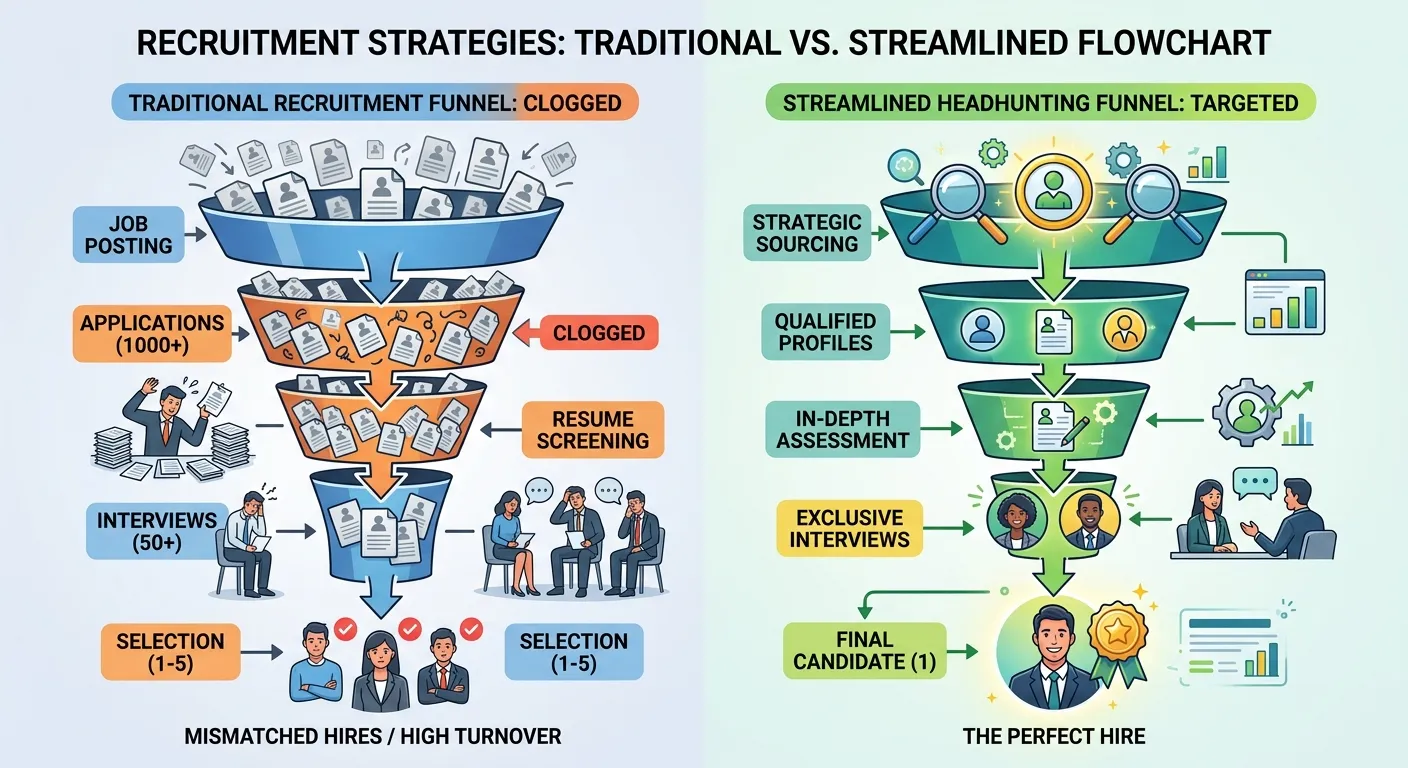
Headhunting, often termed executive search, is a specialized, proactive recruitment strategy focused on identifying, attracting, and securing highly skilled, passive candidates for senior-level, executive, or other critical niche roles. Unlike traditional recruitment which sifts through active applicants, headhunting is a targeted hunt for the"unfindable" talent—individuals who are not actively seeking a new role but possess the exact expertise and experience a company needs to achieve its strategic objectives.
It is a consultative service, deeply intertwined with a company's long-term vision. Whether you need a visionary CTO to lead a digital transformation or specialized Construction Workers for a high-stakes project, understanding what is headhunting in business is the first step to unlocking this elite talent pool. It's the difference between filling a vacancy and acquiring a competitive advantage.
Why Strategic Headhunting is a Business Imperative
For Mission-Critical Leadership
When the success of a department, project, or the entire company hinges on one individual, you cannot rely on job boards. Headhunting targets proven leaders with a track record of delivering results in similar high-stakes environments, ensuring your strategic vision has the captain it needs to succeed.
Confidential & Discreet Searches
Planning a leadership overhaul or replacing a underperforming executive? Public job postings can create internal turmoil and signal weakness to competitors. Headhunting operates with utmost confidentiality, protecting your company's reputation and allowing for smooth transitions. This level of discretion is as vital as the reliable service we provide for Healthcare Staffing, where trust is paramount.
Solving Niche Skill Shortages
In today's rapidly evolving landscape, needs arise for expertise that simply isn't widely available—be it an AI specialist, a biotech regulatory expert, or a master Traffic Marshall for a complex urban development. Headhunters specialize in mapping these niche ecosystems, finding individuals with very specific skill sets who are not browsing generic job sites, much like we connect businesses with specialized On Demand Labourers.
Integrating Headhunting into Your Overall Talent Strategy
Understanding what is headhunting in business allows you to deploy it strategically. It should not replace your entire recruitment function but rather augment it. A robust talent strategy uses the right tool for the right job: headhunting for transformative, niche, and confidential roles; traditional recruitment for high-volume, entry-to-mid-level positions; and a trusted temporary employment agency for flexible, project-based, or seasonal workforce needs.
For example, a construction firm might use headhunting to find a visionary Project Director for a new sustainable city district, utilize our Construction Recruitment Labour Hire UK services for skilled tradespeople, and partner with a temporary employment agency Asheville or similar local provider for short-term administrative support during the peak bidding season. This layered approach ensures all talent needs are met with precision and efficiency.
Pro-Tip: The Internal vs. External Decision
Consider building an in-house talent acquisition team for volume hiring and employer branding. However, for true headhunting, an external firm is almost always superior. They offer an unbiased perspective, have established networks you lack, and their success fee is directly tied to results, aligning their incentives perfectly with yours. Before engaging a headhunter, clarify your Our Approach to collaboration to ensure seamless integration.
The Future of Headhunting: AI, Data, and Personalization
The essence of headhunting—building relationships and assessing intangible qualities—remains human-centric. However, technology is revolutionizing the"search" component. Advanced AI and data analytics tools now allow headhunters to perform hyper-accurate talent mapping, predicting career moves and identifying skill adjacencies with unprecedented speed.
This doesn't replace the headhunter but empowers them. It's akin to how our Industrial Workforce solutions use technology for smarter scheduling and skills matching, while the human touch ensures quality and safety. The future headhunter will leverage AI to handle vast data sets, freeing up more time for the high-value tasks of relationship building, persuasion, and nuanced candidate assessment.
This video explores the shifting landscape of talent and technology, providing context for how human expertise in recruitment remains irreplaceable even in an AI-driven world.
Ready to Hire a Game-Changer?
If your business needs a leader, a specialist, or a niche expert who isn't looking for a job, it's time to start headhunting. Our methodology delivers the talent that transforms organizations.
- Guaranteed Candidate Shortlist
- 120-Day Placement Guarantee
- Confidential Search Execution
For immediate temporary staffing needs, explore our Temporary Jobs portal.
Frequently Asked Questions About Headhunting
Get clear, concise answers to the most common questions surrounding what is headhunting in business and how it works.
Headhunting is typically conducted on a contingency or retained basis. A retained search involves an upfront fee and is standard for executive roles, signifying an exclusive partnership. A contingency search means the headhunter is only paid upon successful placement. Fees generally range from 20% to 35% of the candidate's first-year total compensation. While an investment, it pales in comparison to the cost of a bad hire or a prolonged leadership vacuum. For more predictable costs on volume hiring, see our Services page.
Absolutely not. While classic executive search focuses on the C-suite, modern headhunting is used for any role that is critical, niche, or hard-to-fill. This can include senior individual contributors (e.g., a lead data scientist), specialized technical experts (e.g., a corrosion engineer for oil & gas), or key sales directors. If the role requires specific experience that is scarce in the active job market, headhunting is the appropriate tool, similar to how we source specialized Transport Planners.
This is a crucial distinction. A temporary employment agency Asheville, London, or any city focuses on speed and flexibility to fill short-term, often lower-to-mid-level positions. The candidate is usually an employee of the agency. Headhunting is a strategic, long-term partnership to fill permanent, critical roles with passive candidates. The candidate becomes your direct employee. Think of it as the difference between renting a piece of equipment for a project (temp agency) and buying a key piece of machinery that will be core to your operations for years (headhunting). For temp needs, our Hire Labour service is the ideal solution.
Quality cannot be rushed, but efficiency is key. A typical headhunting assignment for a senior role can take anywhere from 30 to 90 days from kick-off to offer acceptance. This timeline includes research, outreach, interviewing, client interviews, and negotiation. The complexity of the role, the scarcity of talent, and the client's decision-making speed all influence the timeline. This is a deliberate process aimed at securing the best possible fit, contrasting with the immediacy of booking Book Staff for temporary assignments.
Yes, global headhunting is a core service of major executive search firms. They have networks and partners worldwide to identify and attract international talent, managing the complexities of relocation, visas, and cross-cultural integration. This is essential for companies looking to build diverse, global leadership teams. For businesses with multi-site operations, this global reach complements our local expertise in markets across the UK, detailed on our Locations page.
Transform Your Talent Acquisition Strategy Today
Now that you understand what is headhunting in business, take the next step. Stop competing for the active 20% of the job market and start accessing the passive 80% who hold the key to your company's next growth chapter.
For all your staffing needs, from strategic headhunting to reliable temporary labour, explore our comprehensive solutions. Check out the latest opportunities on our Recent Jobs board or learn more about Our Experience.
Case Study: Headhunting in Action
To truly grasp the impact of headhunting, let's examine a real-world scenario where this strategy was the only viable solution for a company facing a critical talent gap.
The Challenge: Scaling a FinTech Startup's Security Infrastructure
A rapidly growing FinTech company, having just secured Series C funding, needed to hire a Chief Information Security Officer (CISO). This wasn't just a compliance role; they needed a visionary who could architect a world-class security framework from the ground up, navigate complex international financial regulations, and instill a culture of security across the engineering teams. The ideal candidate needed a rare blend of deep technical expertise, regulatory knowledge, and proven leadership in a scaling environment.
CLIENT PROFILE
- Industry: Financial Technology
- Size: 300 Employees
- Need: Executive (CISO)
- Key Challenge: Niche skill set, passive candidate pool, confidential search.
1 Why Traditional Recruitment Failed
The company's internal HR team posted the role on major job boards and leveraged their LinkedIn network. The result? Over 200 applications, but fewer than 5 were from candidates with genuine experience in both scalable cloud security and financial services regulation. The active applicant pool consisted largely of corporate CISOs from non-tech industries or infrastructure engineers lacking strategic vision. The process consumed hundreds of hours with no viable candidate in sight after 60 days, putting their expansion roadmap and investor confidence at risk.
This is a classic example where the required talent was not"looking." Top-tier security leaders in tech are heavily recruited and entrenched in their roles.
2 The Headhunting Solution & Process
The company engaged a retained headhunting firm specializing in tech leadership. The process moved through distinct, strategic phases:
- Immersion & Mapping: The headhunter spent a week with the CEO and CTO, understanding the tech stack, growth trajectory, and company culture. Concurrently, they mapped the global landscape of CISOs at high-growth SaaS and FinTech companies, identifying over 40 potential targets.
- Discreet Engagement: Using a combination of warm introductions from their network and highly personalized outreach, the headhunter initiated confidential conversations with 15 prioritized candidates. The pitch focused not on a"job," but on the unique technical challenge and opportunity to build a legacy.
- Rigorous Vetting: Three candidates were presented after a multi-interview assessment that included scenario-based problem-solving on a real (anonymized) security audit finding from the client. This tested practical skill, not just theory.
The Result
Within 10 weeks, the company hired the CISO of a competing unicorn FinTech. The candidate had not applied to any public posting. The headhunter facilitated the negotiation, addressing complex compensation equity and a non-compete clause. 18 months later, the new CISO had not only built the security function but also played a key role in securing a critical banking partnership, directly enabling a new revenue stream. The ROI on the headhunting fee was realized within the first year.
The Anatomy of a Successful Headhunter: Skills & Tools
Behind every successful placement is a professional equipped with a unique blend of human intuition and cutting-edge technology.
The Indispensable Human Skills
Masterful Persuasion & Storytelling
A headhunter must sell an opportunity to a content, passive candidate. This requires crafting a compelling narrative about the client company's mission, the impact of the role, and the candidate's potential legacy. It's not about the job description; it's about selling a vision of the future.
Intuitive Assessment & Cultural Decoding
Beyond checking skills on a CV, a seasoned headhunter assesses motivation, resilience, and cultural fit. They act as a"human lie detector" for both client and candidate, predicting how an individual will navigate the unspoken politics and pressures of the new environment. This skill prevents costly mismatches.
The Modern Technological Arsenal
Predictive Talent Analytics & AI Sourcing
Tools like SeekOut, HireEZ, and AmazingHiring use AI to scan millions of public data points (GitHub, conference papers, patents) to find candidates based on skills, not just job titles. Predictive algorithms can flag professionals likely to be open to new opportunities based on career trajectory patterns, making outreach more efficient.
CRM & Relationship Management Platforms
Specialized recruitment CRMs (e.g., Vincere, Bullhorn) allow headhunters to manage vast networks of thousands of contacts, tracking every interaction, skill note, and career move. This creates a proprietary"living database," ensuring they can instantly identify who to call when a specific need arises, years after first contact.
When NOT to Use a Headhunter: Avoiding Strategic Missteps
Understanding the limits of headhunting is as important as knowing its strengths. Misapplying this tool can lead to unnecessary cost and frustration.
Scenarios Where Headhunting is Not the Optimal Path
High-Volume, Entry-Level Hiring
Need to hire 50 graduate engineers or 100 customer service representatives? Headhunting is prohibitively expensive and inefficient for this. Here, a strong employer brand, campus recruitment programs, and digital recruitment marketing are the correct tools. The goal is to attract a large pool of qualified active candidates.
Roles with Abundant Active Talent
For common roles where quality candidates frequently change jobs (e.g., many mid-level software developer, digital marketing manager, or accountant positions), the active market is robust. A well-crafted job advert on LinkedIn or a specialized job board, managed by a good in-house recruiter, will yield excellent results without the premium cost of headhunting.
Immediate, Short-Term Coverage Needs
If a key employee goes on sudden medical leave or you have a 3-month project spike, you need a temporary solution. This is the domain of a temporary employment agency or a dedicated contractor platform. Headhunting for a permanent hire will take too long. The strategic response here is to secure interim talent while potentially initiating a headhunting search for the permanent replacement concurrently.
When Internal Clarity is Lacking
If the hiring manager and leadership team are not aligned on the role's responsibilities, required skills, or how success will be measured, engaging a headhunter is premature. The search will be flawed from the start. First, conduct an internal job analysis workshop to gain consensus. A good headhunter will facilitate this, but the client must drive the clarity.
The golden rule: Use headhunting for strategic acquisition of scarce, passive talent. Use other recruitment and staffing tools for operational fulfillment of more common or temporary needs.